Free classic receipt template: black and white, HTML to PDF
Published 2 min read
Free template
Use this template for free
Create a free account, make a new template in the Code mode and paste the HTML below. Then send your own data from the API.
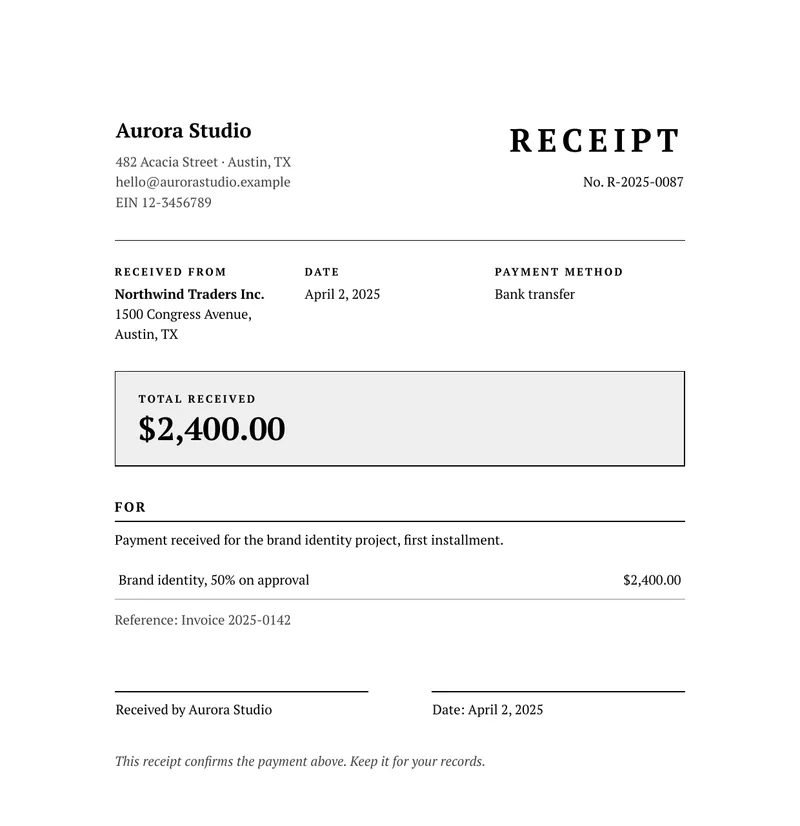
This is the classic style: a serif typeface, black and white, thin rules and a boxed table. It looks the same on any printer, in color or in black and white, and it suits formal documents. A receipt is short and it matters: it is the proof that a payment arrived. This one says who paid, when, how and how much, what the payment was for, and it has a signature line for whoever received it. Below you can download the sample PDF, copy the code and see the data it takes.
What is in the template
- The company block with name, address and tax number.
- The title and the number of the receipt, inside a double frame.
- A received from block with the payer, the date and the payment method.
- A box with the total received, in the currency and the format of the reader’s language.
- A purpose section with a sentence, the lines the payment covers and a reference, such as the number of the invoice it settles.
- A signature line for the company and the date, and a short note at the end.
How to use it
In the portal. Create a free account, click New template, switch to the Code mode and paste the HTML below. You get a live preview.
From the API. Download the HTML and the sample data and send both in one request. This example uses jq to put the files in the body:
curl -X POST https://api.rustedf.com/v1/render \ -H "Authorization: Bearer $RUSTEDF_KEY" \ -H "Content-Type: application/json" \ -d "$(jq -n --rawfile html receipt-classic.html --slurpfile data receipt-classic-data-en.json \ '{html: $html, data: $data[0], locale: $data[0].locale}')" \ -o receipt.pdfOnce you like the result, save the HTML as a template and call it by its id from your code.
Make it yours
- Look. The grays of the header row and of the totals are plain hex colors in the CSS. Change them, or make them white, to print with less ink.
- Lines and amount. The
lineslist holds what the payment covers andamountis the total. Send amounts as strings, such as"2400.00", and work the total out in your own system. - Logo. Add your logo as
<img src="asset:<id>" width="120">after uploading a PNG or JPEG once. - Fonts. The template names
PT Serif, and any Google Fonts family works by name; there is nothing to link. - Language. Every label comes from the
tobject of the data, so the same template issues documents in any language you can write.
A note on what a receipt is
A receipt confirms that a payment was made. It does not replace a tax invoice, and the rules for receipts and invoices differ by country. Check what applies to you before you issue one to a customer.
Other styles
The same data works with the other styles of this document:
See Templates / Locales and formatting.
The template code
<!doctype html>
<html>
  <head>
    <meta charset="utf-8" />
    <style>
      @page { size: A4; margin: 18mm; }
      body { font-family: "PT Serif", serif; font-size: 10pt; color: #000000; line-height: 1.5; }
      table { width: 100%; border-collapse: collapse; }
      td, th { vertical-align: top; }
      p { margin: 0; }
      .muted { color: #444444; }
      .right { text-align: right; }

      .frame { border: 3px double #000000; padding: 10mm 10mm 12mm 10mm; }
      .name { font-size: 15pt; font-weight: bold; margin-bottom: 1.5mm; }
      .kind { font-size: 24pt; font-weight: bold; text-transform: uppercase; letter-spacing: 4pt; text-align: right; }
      .ref { text-align: right; margin-top: 2mm; }
      .rule { border-top: 1px solid #000000; margin: 7mm 0 6mm 0; }

      .label { font-size: 8pt; font-weight: bold; text-transform: uppercase; letter-spacing: 1.4pt; margin-bottom: 1mm; }
      .fields td { padding: 0 6mm 5mm 0; width: 33%; }

      .amount { border: 1px solid #000000; background: #efefef; padding: 5mm 6mm; margin-top: 2mm; }
      .big { font-size: 24pt; font-weight: bold; line-height: 1.1; }

      h2 { font-size: 10pt; text-transform: uppercase; letter-spacing: 1.2pt; margin: 8mm 0 2mm 0; padding-bottom: 1mm; border-bottom: 1px solid #000000; }
      .lines td { padding: 2.2mm 1mm; border-bottom: 1px solid #8a8a8a; }

      .sign { margin-top: 16mm; }
      .sign td { width: 45%; padding-top: 2mm; border-top: 1px solid #000000; }
      .sign .gap { width: 10%; border-top: 0; }
      .note { margin-top: 8mm; font-style: italic; }
    </style>
  </head>
  <body>
    <div class="frame">
      <table>
        <tr>
          <td style="width: 55%">
            <p class="name">{{ company.name }}</p>
            <p class="muted">{{ company.line1 }}<br />{{ company.line2 }}<br />{{ company.tax }}</p>
          </td>
          <td>
            <p class="kind">{{ t.title }}</p>
            <p class="ref">{{ t.number }} {{ number }}</p>
          </td>
        </tr>
      </table>

      <div class="rule"></div>

      <table class="fields">
        <tr>
          <td>
            <p class="label">{{ t.received_from }}</p>
            <p><strong>{{ payer.name }}</strong><br />{{ payer.line1 }}</p>
          </td>
          <td>
            <p class="label">{{ t.date }}</p>
            <p>{{ issued | date(style="long") }}</p>
          </td>
          <td>
            <p class="label">{{ t.method }}</p>
            <p>{{ method }}</p>
          </td>
        </tr>
      </table>

      <div class="amount">
        <p class="label">{{ t.total_received }}</p>
        <p class="big">{{ amount | currency(code=currency) }}</p>
      </div>

      <h2>{{ t.purpose }}</h2>
      <p>{{ description }}</p>
      <table class="lines" style="margin-top: 3mm">
        {% for line in lines %}
        <tr>
          <td>{{ line.name }}</td>
          <td class="right">{{ line.amount | currency(code=currency) }}</td>
        </tr>
        {% endfor %}
      </table>
      <p class="muted" style="margin-top: 3mm">{{ t.reference }}: {{ reference }}</p>

      <table class="sign">
        <tr>
          <td>{{ t.received_by }} {{ company.name }}</td>
          <td class="gap"></td>
          <td>{{ t.date }}: {{ issued | date(style="long") }}</td>
        </tr>
      </table>

      <p class="note muted">{{ note }}</p>
    </div>
  </body>
</html>
The sample data
{
  "locale": "en-US",
  "currency": "USD",
  "number": "R-2025-0087",
  "issued": "2025-04-02",
  "company": {
    "name": "Aurora Studio",
    "line1": "482 Acacia Street · Austin, TX",
    "line2": "[email protected]",
    "tax": "EIN 12-3456789"
  },
  "payer": {
    "name": "Northwind Traders Inc.",
    "line1": "1500 Congress Avenue, Austin, TX"
  },
  "method": "Bank transfer",
  "reference": "Invoice 2025-0142",
  "description": "Payment received for the brand identity project, first installment.",
  "lines": [
    { "name": "Brand identity, 50% on approval", "amount": "2400.00" }
  ],
  "amount": "2400.00",
  "note": "This receipt confirms the payment above. Keep it for your records.",
  "t": {
    "title": "Receipt",
    "number": "No.",
    "received_from": "Received from",
    "date": "Date",
    "method": "Payment method",
    "total_received": "Total received",
    "purpose": "For",
    "reference": "Reference",
    "received_by": "Received by"
  }
}Keep reading
More styles
Google Fonts in a PDF: use font-family without @font-face
Use any Google Fonts family in a PDF by naming it in CSS. How the font is fetched and cached, the built-in fallbacks, bold and italic, and what does not work.
3 min read
More styles
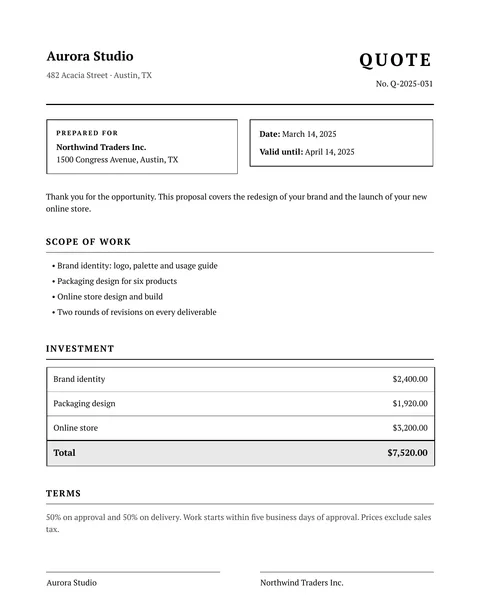
Free classic quote template: black and white, HTML to PDF
A free classic quote in HTML and CSS: serif type, black and white, scope of work, a price table, terms and signature lines. Copy it and use your own data.
2 min read
More styles
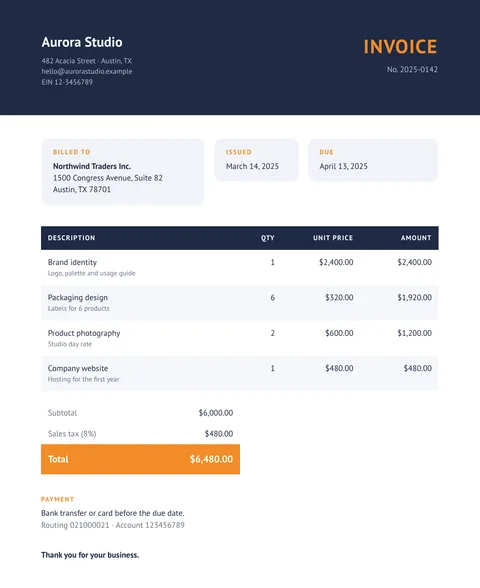
Free modern invoice template with a colored header, HTML to PDF
A free modern invoice in HTML and CSS: a dark header band, rounded cards, striped rows and an accent color for the total. Copy it and use your data.
2 min read
More styles
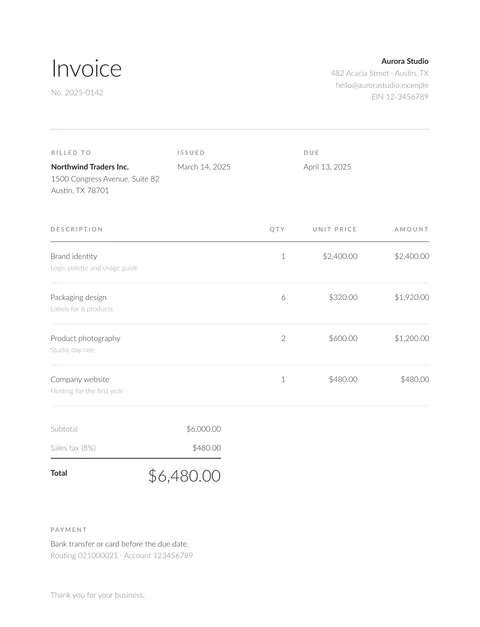
Free minimal invoice template: clean and simple, HTML to PDF
A free minimal invoice in HTML and CSS: light type, white space and hairlines, with no color at all. Copy the code and fill it with your own data.
2 min read